AIMarketInfrastructureOriginal
Training vs. inference: AI is drawing two different data center maps

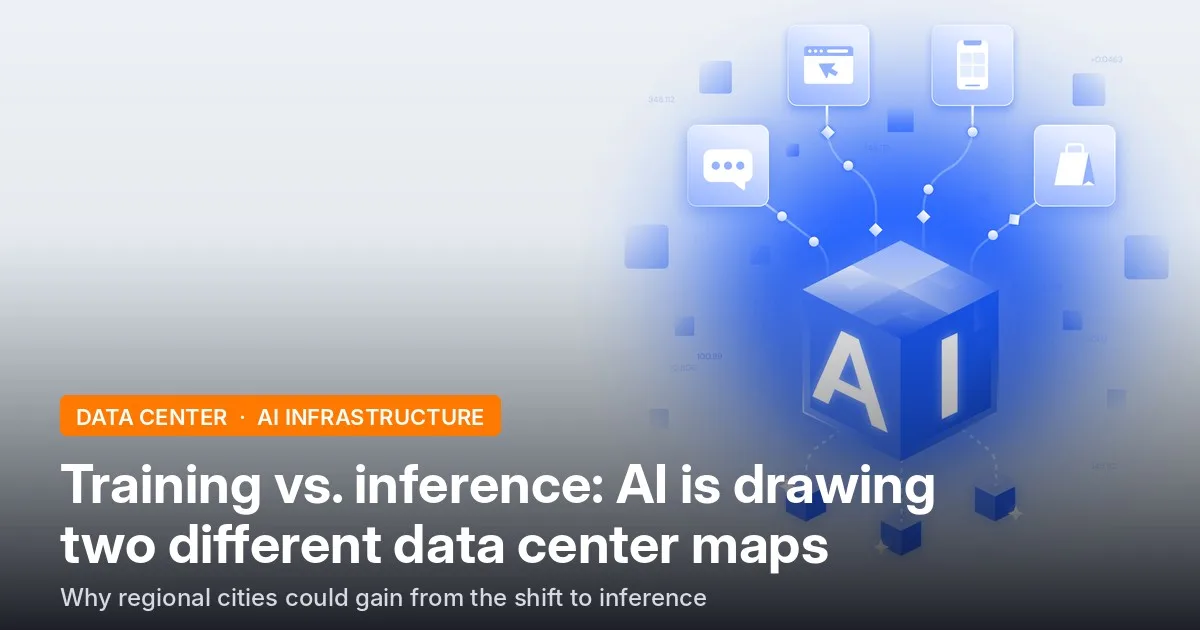
For the past three years, the AI build-out has been described mostly in terms of size: how many gigawatts, how many GPUs, how many billions. Location came second. That is starting to change as spending moves from training models to running them, because the two workloads want to live in different places.
Training goes where the power is
A training cluster mostly talks to itself. Thousands of accelerators exchange data over an internal fabric for weeks at a time, and a few fiber links are enough to send datasets in and pull checkpoints out. The cluster needs power, land and room to grow quickly. Being close to a city adds little and usually costs a lot.
The flagship projects follow that logic. OpenAI's first Stargate site in Abilene, Texas, sits on a field northwest of the town, chosen for cheap wind power and plenty of space, and is planned to reach around 1.2 GW across eight buildings. Meta's Hyperion campus is going up in rural Richland Parish, Louisiana, where at least 5,000 temporary workers have arrived in a parish of roughly 20,000 residents. Other Stargate sites are in Shackelford County, Texas, Doña Ana County, New Mexico, and a former GM plant in Lordstown, Ohio.
Europe and Asia show the same pattern. JLL's mid-2026 EMEA report found that hyperscale campuses planned in Europe for 2026 to 2028 will sit an average of 175 km from the major hub cities, against 46 km for projects delivered between 2022 and 2025. In Japan, where about 90% of data centers are in Greater Tokyo and Greater Osaka, planners are looking at Hokkaido and other regions with surplus renewables for the next large blocks of capacity. In the US, CBRE notes that structured financing is flowing into AI-factory mega-campuses in tertiary markets, and that power cost and delivery speed now outweigh connectivity in site selection.
Inference is becoming the bigger workload
Forecasts disagree on timing but agree on direction. Deloitte expects inference to account for roughly two-thirds of all AI compute in 2026, up from a third in 2023 and half in 2025. JLL puts the crossover for data center capacity at 2027. ABI Research is more cautious and sees inference overtaking training in cloud capacity by 2033, reaching 46 GW by 2035. McKinsey expects inference to represent more than half of AI compute and 30 to 40% of total data center demand by 2030.
The gaps come from what each firm measures (compute, power or spending) and where it files post-training and fine-tuning. Training keeps growing in every one of these scenarios, just more slowly than inference.
Why inference cares about distance
Inference serves people and machines over public networks, so every round trip adds to the wait. Researchers studying centralized deployments estimate that round trips between cloud regions and end-user devices typically run 50 to 150 ms, and network latency often makes up 20 to 40% of end-user inference latency.
For a chatbot writing a few paragraphs, that hardly matters. Most of the wait comes from the model generating tokens, and a user in Lyon won't notice whether the GPU is in Paris or in Virginia. A recent Cisco white paper says as much: network latency has historically been a secondary concern for LLM inference. The same paper expects that to change. As inter-token latency falls and agentic workflows chain several model calls for each user request, the network's share of total response time grows. An agent that makes twenty sequential calls pays the round trip twenty times.
Other pressures push in the same direction. Voice assistants, real-time video analytics, industrial control and fraud detection have tight latency budgets. Shipping large volumes of video or sensor data to a distant region is expensive. And with data protection laws now in force in 144 countries, more enterprise and public-sector inference has to stay inside a given jurisdiction.
Most of the industry now describes the result as a layered model. Akamai's version: training wants density, regional inference wants throughput and edge inference wants proximity. McKinsey notes that while training needs large, high-density campuses, inference is driving build-outs in metro and near-metro sites. JLL expects the shift to redistribute workloads from centralized clusters to distributed regional hubs.
Where regional cities fit
The big hubs are full. CBRE reports record-low vacancy of 0.3% in Northern Virginia and 1% in Atlanta, and JLL puts vacancy across Frankfurt, London, Amsterdam, Paris and Dublin at 6.4%, with Frankfurt at 3.1%. The gigawatt campuses, meanwhile, are often too far from users for latency-sensitive work. A regional city with a few hundred thousand to a few million people, decent fiber and some spare power sits in between.
In the United States, the gap is often interconnection. Telecom veteran Hunter Newby, who mapped exchange points using PeeringDB data, argues that the move to inference will expose the fact that many US states have no internet exchange point at all. His joint venture with the nonprofit Connected Nation aims to build carrier-neutral exchanges in 125 regional hub communities across 43 states and four territories, starting with Wichita, Kansas. Progress has been slow, a sign of how hard this layer is to build.
India is moving faster. IDC expects AI workloads over the next three to four years to drive demand for edge data centers in Tier II cities, closer to customers and to where data is generated. Hyderabad, already a major hub, is getting a 400 MW AI campus from NTT DATA and Neysa.
In Japan, Osaka is the clearest case of a second city gaining ground, with JLL projecting 170% capacity growth for Greater Osaka. Analysts describe Japan's AI infrastructure as splitting into high-value metro capacity for latency-sensitive workloads and larger campuses in power-rich regions.
Latin America posted the fastest growth CBRE tracked: capacity in São Paulo, Querétaro, Santiago and Bogotá rose 41.3% year over year to 1,045 MW in Q1 2026. As local AI use grows, serving it from US facilities gets harder to justify on latency and sovereignty grounds.
In Europe, Cushman & Wakefield sees Madrid, Oslo, Warsaw, Vienna and Barcelona gaining from faster power delivery, available land and good connectivity. Cities like Marseille, Milan or Munich, which pair a regional economy with strong network infrastructure, are natural candidates for inference capacity serving their surrounding regions.
What could get in the way
Much of the case for inference at the edge comes from companies that sell exactly that. Equinix, Akamai and other interconnection players have every reason to stress latency. Hyperscalers, for their part, have so far served most generative AI traffic from a limited number of large regions, and it has worked well enough. If chatbots and copilots stay the dominant use, a few big inference regions per continent may cover most demand.
Power is as scarce in many regional cities as in the hubs, sometimes more so. An inference rack is still a high-density rack, and a metro without grid capacity won't attract GPUs on location alone. CBRE's point about power beating connectivity applies to inference too.
There's also the installed base. McKinsey points out that much of today's installed base was designed for training and is now being used for inference. While that capacity is available, operators will fill it before building new sites near users.
Cities also need neutral interconnection, carrier diversity, local cloud on-ramps and operators willing to take the commercial risk. Practitioner data cited by Akamai shows that only 30% of early-stage AI experimenters prioritize proximity, rising to 77% once workloads reach production. The demand will come from production workloads, and many of those are still being designed.
Two maps
Training will keep moving toward wherever large amounts of power can be delivered fast: West Texas, the Nordics, northern Japan, the Gulf. Inference will spread more widely, with large regional hubs handling bulk traffic and smaller metro facilities taking the workloads that can't tolerate distance, heavy data movement or a foreign jurisdiction.
For regional cities the opportunity exists, but it is narrower than the most optimistic pitches suggest. The ones likely to benefit already have, or can quickly build, available power, carrier-neutral interconnection and a local economy generating enough AI traffic to justify the investment. A city with only one of those may watch the GPUs go somewhere else.